Sunday, January 19, 2014

Lago Llanquihue

One of our highlights from our 2013 Road Trip was Lago Llanquihue and its charming lakeside villages. We returned to the lake as the southern-most point on our trip, but as with Pucón, decided to stay out of the towns and along the lake shore. We found a cabaña between Puerto Varas and Volcán Osorno with access to the lake, which was very idyllic.

Volcán Osorno from Puerto Varas

Sunset over Volcán Osorno from our cabaña

We have previously driven east around Lago Llanquihue to Volcán Osorno and Saltos de Petrohué, so on this trip we decided to go clockwise around the lake and up to Puerto Octay. We had read excellent things about Puerto Octay in our guidebook, but the reality was a little less charming than the Eyewitness Travel's superlatives.

Map of Lago Llanquihue

View over Puerto Octay - pretty from a distance!
Needless to say, we hastened back to our old favourite, Frutillar. It was no less lovely this time around and we had time to explore the town properly. We visited the Museo Colonial Alemaán which recreates pioneer-era life with life size buildings, including a mill, a farmhouse and a blacksmith's forge. The landscaped gardens are beautiful and the buildings and artefacts very interesting.


The mill in the Colonial German Musem

Us with Lago Llanquihue and Volcán Osorno in the background

The iconic treble clef tree on the lake edge. Frutillar is famous for its music festivals

While Daniel went out for a long run, I headed to the Reserva Forestal Edmundo Winkler, a forestry school sanctuary which has a short trail through the woods at the northern edge of Frutillar. I saw some exquisite hummingbirds in the Valdivian forest, as well Laurel trees which were hundreds of years old.

A 700-year-old Laurel tree


Pucón

We visited Lago Villarica for the third time since our arrival in Chile, this time staying along the shore between Villarica and Pucón. We holed up in a picturesque little cabin for a couple of nights.

Our cabin, halfway between Villarica and Pucón

Pucón is a bustling little town which is very popular among Chile's more affluent citizens (e.g. my students!). It's a great town with lots of activities to keep its visitors entertained, including water sports and adrenaline-charged excursions. We settled for a simple stroll around town and a quiet lunch.

Colourful boats on Lago Villarica

Charming streets in Pucón
The town's natural surroundings include the black shores of the lake and Volcán Villarica. We didn't hit the beach during our stay, but we did go the entrance of Parque Nacional Villarica where we did a small interpretative trail loop. We saw the beautiful flowers of the wild Hummingbird fuschia (Fuschia magellanica), leaf-lined forest paths, the passage of the lava flow from the last eruption and a cute little fox. Unfortunately the volcano stayed hidden behind the clouds while we were there.

The Hummingbird fuschia

Volcán Villarica (aka the Denali of Chile - always behind clouds!)

Parque Nacional Conguillío

Our second stop on our trip south was at Parque Conguillío, one of the Lake District's best natural attractions, where we camped for the night.

The Conguillío National Park is dominated by Volcán Llaima which has shaped the park's landscape dramatically. The first 10km into the park are characterised by deep valleys scarred by jagged lava flows. The volcano last erupted in 2008-9 and the landscape is now dark and rock-filled where forests once stood.

Volcán Llaima, which last erupted in 2008-9,
and the landscape blackened by its lava flows.

The park is famous for its ancient Araucaria forests, and the Araucaria is the national tree of Chile. The name Conguillío derives from the Mapuche word for "water with Araucaria seeds". The English nickname for this tree is a monkey puzzle tree.

A giant Araucaria tree

The park has excellent camping and trail facilities and we enjoyed a walk through parts of the national forest. We walked to the first mirador of the popular Sierra Nevada trail and on the way back we saw a pair of Magellanic Woodpeckers, South America's largest woodpecker. They are huge!

Part of the Sierra Nevada trail

We also visited Lago Captrén, a shallow lake which was formed when lava flows from Volcán Llaima obstructed the Río Captrén. The lake formed where there was previously a forest and now there is a large underwater forest, with the tips of dead trunks piercing the surface of the lake. It's quite eerie to see the large, submerged logs lying in the green water.

Lago Captrén, the underwater forest

A consequence of the volcanic eruption and its destruction of the landscape can be seen in the new growth in the park. Where there were once expansive forests, trees now struggle to grow and this has resulted in natural bonsai trees fighting through the volcanic rock. It's very cute to see the little splashes of life in the bleak landscape.

A natural bonsai

Our last stop in the park was at the Trufel Trufel waterfalls. We walked a small loop through the lava field and volcanic debris to see the beautiful river canyon and the waterfalls.

Río Captrén

Saltos de Truful Trufel


Santa Cruz

Santa Cruz is one of the largest towns in the Colchagua Valley, Chile's premier wine-producing region which stretches from the foothills of the Andes towards the Pacific coast. The town itself has not been very well developed, but the surrounding vineyards are beautiful and well worth a visit.

We went to Viña MontGras, which had an impressive colonial hacienda and offered the best wine tour we've ever been on. We arrived a bit early and were offered a complimentary bottle of chilled Sauvignon Blanc while we waited. On the tour, we got to go into the rows of vines and see the leaves and grapes and soil; we tasted some Chardonnay from the tiny tap on the giant fermentation tank (it needed a while yet); we dipped our fingers into a barrel of Cabernet Sauvignon (very smooth and nearly ready); and we tasted four different types of wine with a group of fun Colombians. At the conclusion of the tour, we bought some good bottles of wine for our road trip and we received a complimentary bottle opener. What a great afternoon!

Viña MontGras

The courtyard where we did the wine-tasting

The vineyards. These are rows of Cab Sav grapes.

Grenache grapes which we crushed to see their red juice.

Our table at the end of a very successful wine tasting!

Road Trip II

It's summer holidays again and Daniel and I took off once more to the south of Chile. We decided to revisit some old haunts from our trip last year and check out some new locations.

Highlights included delicious wine in Santa Cruz, spectacular landscape, woodpeckers and bonsais in Conguillío, lots of kuchen in Lago Llanquihue, and a forest full of fireflies and copihue in Concepcion.

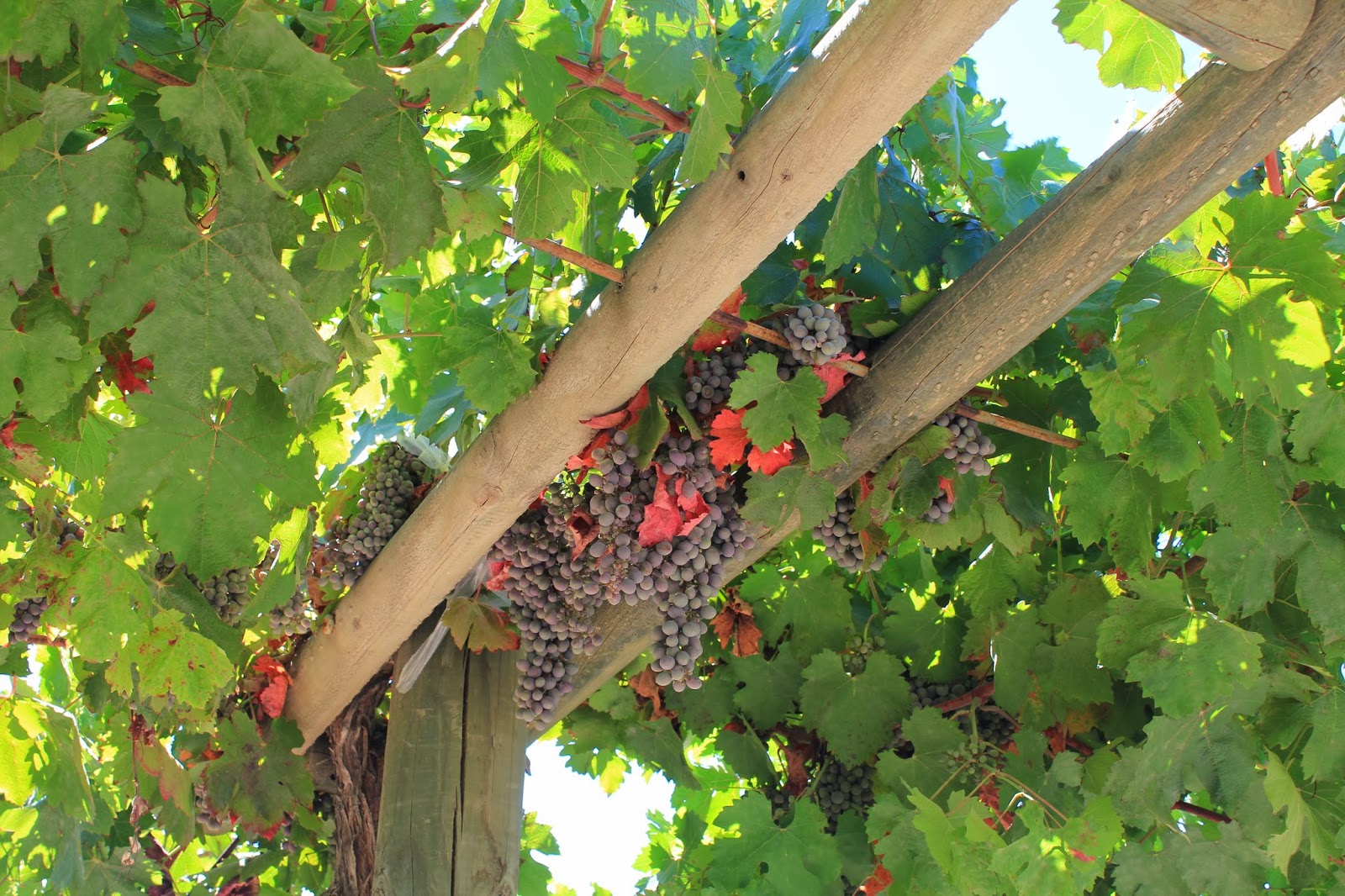
Grapes at Viña MontGras

A baby Araucaria tree in our campsite

Us at the Salto del Truful Truful in Parque Conguillío

During our 3,450km journey, we visited:

Santa Cruz
Parque Conguillío
Pucón
Lago Llanquihue (and its Teutonic buildings)
Huilo Huilo
Concepción

Tuesday, December 3, 2013

Boragó - gourmet dining

As a birthday treat, Daniel took me to the famous Boragó restaurant in Santiago. The restaurant sources all of its ingredients from within Chile. While fish and other meat may be sent up from organic farms in the south, the team of chefs forage for herbs, mushrooms, sea weed and other delicacies themselves. In the restaurant, diners can watch the chefs plating up each dish in the kitchen


Watching the chefs at work


Mora berry pisco sour to start

Boragó creates its own tasting menu for its diners, choosing delicacies from around Chile and turning them into gastronomical masterpieces. All the dishes are served on unique plates made from slate, granite, wood, rock, clay, etc. The portion sizes may be tiny, but the taste is explosive!


Chancharro y nalcas de Chiloé

Chupe de setas de pino

Corvina y hierbas de playa

Ternera y su leche


Chirimoya contenta y zanahoria

Each tasting was accompanied by delicious Chilean wine pairings. We sampled some amazing boutique wines and I particularly enjoyed drinking chicha out of a calf horn!

Chicha served in a calf horn. Apparently the president drinks
it like this every 19 September.


The chicha was served with Oveja y ruibarbo chilote
(a.k.a manjar candy floss and marshmallow sheep!)

At the end of the dinner, our waiter brought us a rock with two tiny round white crisps on it. We scooped them up on our fingers and popped them into our mouths. A second later we were breathing smoke through our mouths, nostrils and ears! It was a mint-flavoured 'glacial ice', a real palette cleanser to round off a superb evening of fine dining.

Friday, October 25, 2013

Overall Winner - Kalahari Augrabies Extreme Marathon

Daniel participated in his first ultra marathon in South Africa and he won the race in a course record of 22:02:57! His dad and brother also ran the race and the family in luminous green were the first father-and-sons team to finish the race.

Looking strong!

Daniel in action on Stage 4

The Rowland family at the finish line

Sunday, September 8, 2013

Rio de Janeiro

At the end of August I travelled to Rio de Janeiro for a three-day IB conference. I tacked a couple of days onto the end of the course for myself so I could explore the Brazilian city. Rio is a fascinating blend of rich and poor, tourist and local. The conference was at the American School, a high-tech secure location adjacent to a favela, a Brazilian shanty town. Everywhere we went in Rio, we passed favelas and mansions within blocks of each other. What a contrast!

View of a favela from the American School

Apart from this stark contrast, Rio is also characterised by its many beaches. My hotel was on the Copacabana Beach, a 4km stretch of white sand, palm trees and cafes. I stopped for some agua de coco (coconut water) and, of course, some typical Brazilian caipirinhas (cocktails).

Enjoying agua de coco on Copacabana Beach

Some sandcastles on Copacabana Beach advertising the
2014 Soccer World Cup and 2016 Olympic Games coming to Rio.

I went on a tour of the very hilly city to see the famous sites. The tour took us past some cathedrals, the famous Maracanã Soccer Stadium and the Sambódromo, a venue for the float parades in the Rio Carnival. We also went up Corcovado Hill in the Tijuca National Forest to see the Christ the Redeemer statue and enjoy spectacular views over the city.

Cristo Redentor watching over Rio de Janeiro

In front of the Christ the Redeemer statue

A beautiful view over Rio

The last stop on the tour was a cable car ride up Sugarloaf Mountain (Pão de Açúcar), a peak at the mouth of Guanabara Bay, with views over the bay, the Yacht Club and the statue of Christ. I enjoyed a beautiful sunset there before returning for my last caipirinha in Brazil.

The cable car descending from Sugarloaf

Monday, July 15, 2013

Mendoza

We treated ourselves to a weekend trip across the border to Mendoza, Argentina. Mendoza lies in the foothills on the eastern side of the Andes, and is frequently visited by Chileans looking for some great steak!

The city coat of arms lit up at night

Plaza Independencia, a vibrant park which attracts tourists and Mendocinos alike

All the fountains in the plaza had blue water - very patriotic!

Mendoza is most famous for its olive oil production and its wine making. It is the largest wine-producing area in South America and is home to 1,400 wineries! We went on a fantastic tour of the region, stopping at two vineyards (Vistandes and Viña del Cerno), an olive oil farm (PasRai) and a home-industries shop (A la Antigua).

Wine tasting for two!
At each vineyard we received a private tour in English.
Oak barrels at Vistandes wine estate
Flavoured olive oils drizzled on sundried tomato and olive pestos
Sampling some delicious homemade olive pastes at A la Antigua

It's always nice to travel to new places, but Mendoza did not make our list of 'best places visited'. While the wine tour was excellent, we found the city itself to be lacking in the charm and appeal which we had heard so much about.